
How to Ask Customers for Google Reviews: Script, Timing, QR Code
On this page
Most businesses do not have a review problem. They have an asking problem.
The customer who just told you the fade was perfect, or that the lock got fixed the same night, would have left a review. Nobody asked. Multiply that by every customer this year and that is the gap between your listing and the one three doors down.
Here is how to close it, without tricks and without spending a dollar.
Get the link and QR code Google already gave you
You do not need a review company to make a review link. Google makes one for every verified business.
Search your business name on Google while signed in to the account that runs your listing. In the panel for your business, tap Ask for reviews. Google shows a short link that opens straight to the review box, and a QR code that does the same thing from a phone camera.
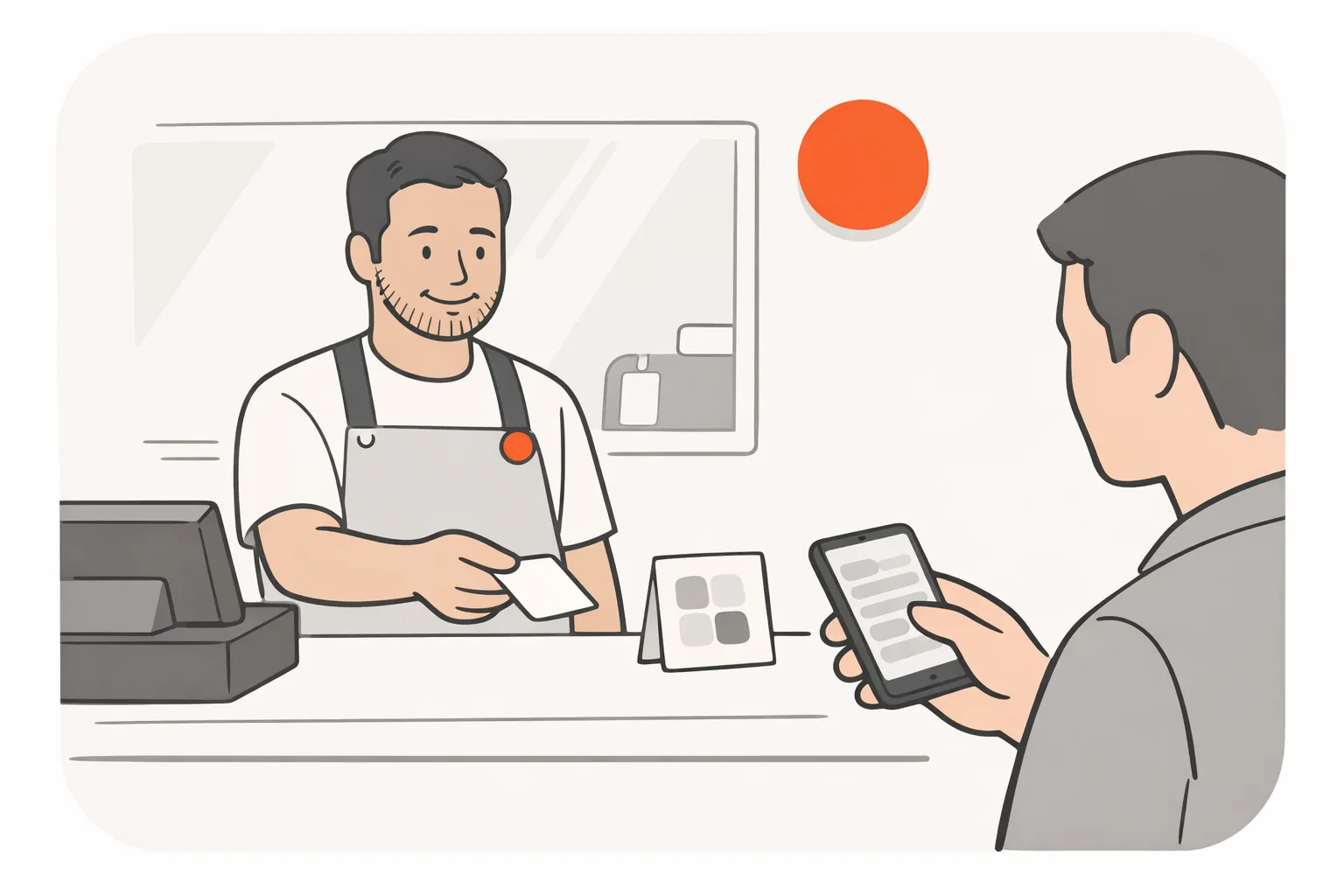
Save the link in your phone. Print the QR code once and put it where customers already look: the counter, the bottom of the receipt, the mirror, the back of the van door. A customer who scans it is one tap from the review box, with no searching for your listing and no hunting for the button.
That is the whole setup. Everything else is the ask.
The script, in three versions
The ask works when it is short, honest, and easy to say no to. Copy these and change the trade.
In person, at the end of the visit:
If you were happy with today, a Google review would mean a lot. It takes about a minute, and the link is on the receipt.
By text, the same day:
Thanks for coming in today. If you have a minute, a Google review helps us more than anything: [link]. No worries if not.
By email, when text is not your style:
Subject: One quick favor
Thanks for trusting us with the job today. If you have a minute, a Google review is the single most helpful thing a customer can do for a small business. Here is the link: [link]. Either way, thank you.
Three things make these work. They say why it matters, in one clause. They say how long it takes. And they give an out, which is what makes the yes feel like the customer's idea.
Do not explain the review system, do not send a paragraph, and never tell them what to write or how many stars. People can smell a script that is trying too hard.
Ask the same day, and remind once
Timing does most of the work. The best moment is the end of the visit, when the result is in front of them and the feeling is still there. Second best is a text within a few hours, while the day is still today.
By the next morning the visit is a memory. By next week it is gone, and the ask reads as odd.
If nothing happens, one reminder, three or four days later, is polite. Two is pestering. After that, let it go and ask again the next time they come in. Regulars can be asked once a visit, not once a week.
The mistake most owners make is the opposite of nagging. They ask once, in a good month, then never again. Reviews come from a habit, not a campaign. Put the ask in the same place every time: the last line of the invoice, the goodbye at the door, the thank-you text.
Everyone gets asked
The part that trips people up: Google's review policy bans asking only the customers you expect to be happy. Screening customers first, or sending the link only to people who rated you well in a private survey, is called review gating, and Google removes reviews it catches this way.
So the rule is simple. Everyone who bought from you gets the same ask, the same day, the same link.
This is also better for you. A listing with 40 reviews that are all five stars and all sound the same reads as bought, to people and to Google. A listing with 40 reviews at 4.8, with a couple of grumbles and calm owner replies under them, reads as real. Real is what wins the tap.
The rare bad review you get from asking everyone is worth less than you fear. See the arithmetic below.
Never pay, never trade
The other rule: nothing in exchange for a review. No discount, no free add-on, no raffle entry, no "leave us five stars and get ten percent off." Google's policy bans all of it, and in the United States the FTC's rule on fake reviews, in force since October 2024, allows fines for buying or selling them.
The same goes for reviews from staff, family, or a friend's phone, and for anyone who offers to sell you fifty reviews for a hundred dollars. Bought reviews get removed in batches, sometimes months later, and the profile can be restricted. It is the review version of the SEO pitches to hang up on.
You can thank a customer for a review. You cannot pay for one.
What one review actually does to your rating
Owners chase rating. Here is what a review does to it, honestly.
Google shows your total stars divided by your review count, rounded to one decimal. So the effect of any single review depends on how many you already have.
- 20 reviews at 4.3. Six new five-star reviews lift the display to 4.5.
- 200 reviews at 4.3. It takes about 55.
- Ten reviews at 5.0, then one one-star. The display drops to 4.6, and it takes about 70 five-star reviews to show 5.0 again.
Two things follow. A young listing moves fast, so the first 30 reviews are the ones that set your rating for a long time. And a listing with a few hundred reviews barely moves, in either direction, which is why one bad review is not the emergency it feels like.
It also means the count matters as much as the number. A 4.7 with 180 reviews beats a 5.0 with six, to a customer and to Google.
Where the review goes next
A review that lands on your listing does two more jobs if you let it.
First, reply to it. Google's own tips for getting more reviews include replying, because customers who see the owner answer are more likely to leave one. A short, specific reply to a good review and a calm one to a bad review are both public, and both are read by the next customer. We write those replies for you, sent to your inbox for a one-tap approve.
Second, put it on your website. The words a customer wrote are the best words on your site, and they only count if they are on the page as text. Screenshots and widgets that load later are mostly invisible to Google and to chat bots like ChatGPT. Here is how to get reviews on your website as text, and why it matters.
Make the ask a habit, or have it done for you
The link and the script take ten minutes to set up. The hard part is doing it every day for a year, on the days you are slammed and the days you forget.
That is why asking for reviews is part of the service we run for every business we build a site for. You get your own review link and QR code, and the polite asks go out for you, paced so nobody is pestered. Everyone gets asked, because that is the rule and because it is the reason the reviews read as real.
Related reading: Get More Google Reviews and putting your Google reviews on your website.
Type your business name at 30secondsites.com and see the site built from your Google listing, reviews and all. Looking is free. No card, no login, no email until you want to keep it.
Questions
Asked about this, answered plainly
How do you politely ask for a Google review?
One sentence, said like a person, with an easy out. In the shop: "If you were happy with today, a Google review would mean a lot. Takes about a minute, here is the link." By text: "Thanks for coming in today. If you have a minute, a Google review helps us more than anything: [link]. No worries if not." Do not pitch it, do not explain how reviews work, and never tell them what to write.
What is the fastest way to get Google reviews?
Ask the customers you already have, today, with the link in hand. Most businesses have hundreds of past customers who were never asked. One short text to everyone from the last month, with your review link, is the fastest honest way to get reviews. Anything faster than asking real customers is buying them, and Google removes bought reviews.
Is it legal to buy Google reviews?
No. Google's review policy bans paying for reviews with money, discounts, or gifts, removes reviews it catches, and can restrict the whole profile. In the United States the FTC's rule on fake reviews, in force since October 2024, allows fines for buying or selling them. Google also bans asking only your happy customers. Everyone who bought from you gets the same ask.
How many 5-star reviews does it take to increase a Google rating?
It depends entirely on how many reviews you already have. With 20 reviews averaging 4.3, six five-star reviews lift the displayed rating to 4.5. With 200 reviews averaging 4.3, it takes about 55. Google shows total stars divided by review count, rounded to one decimal, so a big review count moves slowly in both directions. That is also why one bad review barely dents a listing with a hundred good ones.
Are you allowed to ask for Google reviews?
Yes. Google's own help pages tell you to ask and give you the link and QR code to do it with. What is not allowed is paying for reviews, offering anything in return, asking only the customers you expect to be happy, having staff or family review you, or writing reviews yourself. Ask everyone, offer nothing, and let them write what they want.